
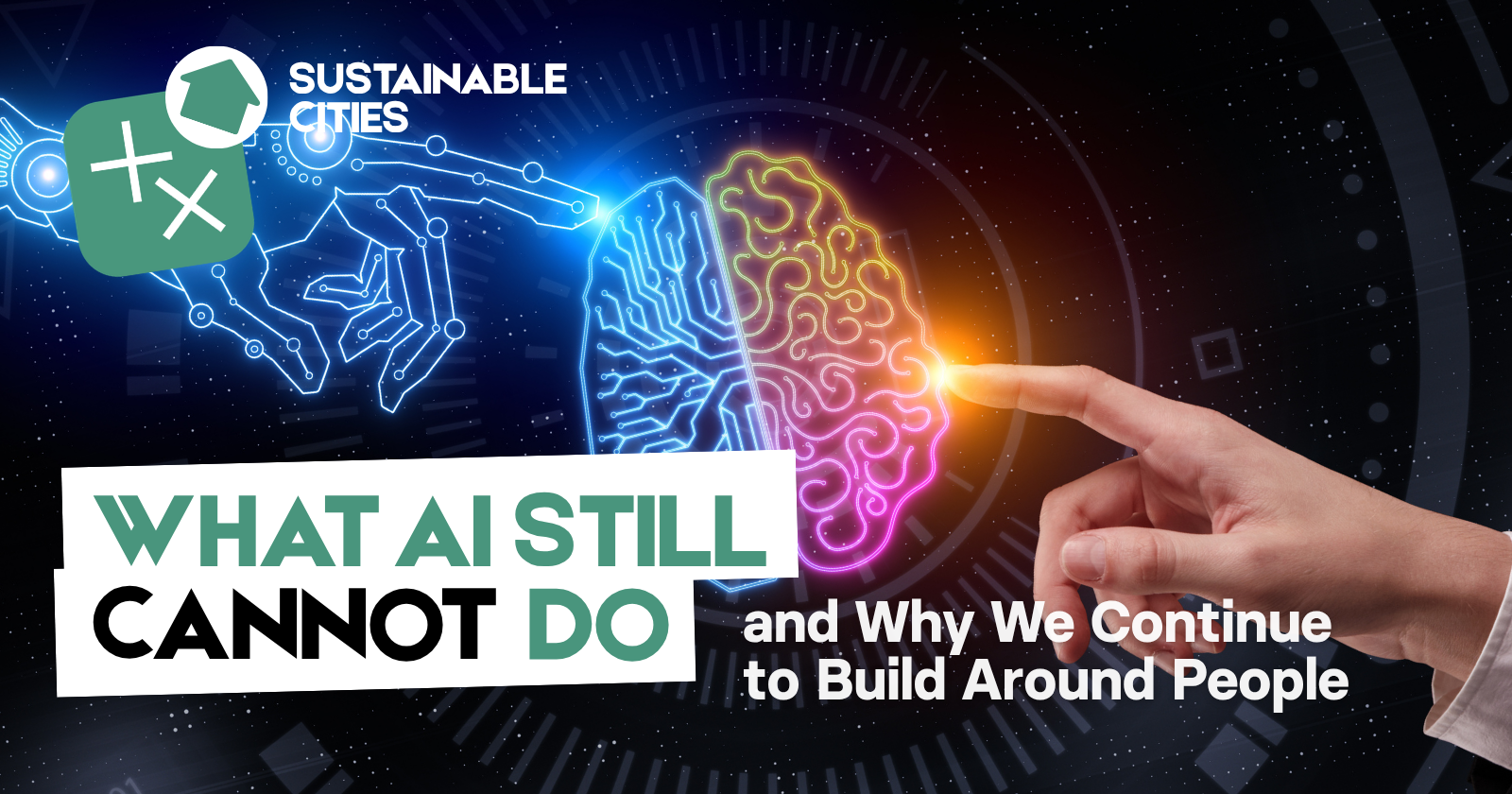
What AI Still Cannot Do – and Why We Continue to Build Around People
We didn’t start a stopwatch at Parcel+Post Expo in London, but it felt as though “AI” or “AI agent” came up every four seconds.
We saw impressive developments: smarter planning, automated processes and more accurate forecasting. Yet many conversations returned to the same question: how can we save a few more seconds, operate with less human labour and make delivery more predictable?
At TOURMIX, we are also interested in how technology can help us work better together – while building more liveable cities and stronger communities.
A Good Response Does Not Necessarily Mean Human Understanding
AI can write a thoughtful-sounding message, recognise certain patterns and suggest what to do in a difficult situation. That does not mean it experiences another person’s circumstances or takes personal responsibility for them.
In delivery, this distinction appears in everyday situations. A recipient takes a little longer to reach the door. Someone is unsure about how to receive their parcel. A few words and a little patience resolve an unexpected problem.
Some aspects of these situations can be automated. But personal presence, local knowledge and attentiveness can together provide value that a digital response alone cannot replace.
AI Can Optimise. We Must Define the Goal.
An algorithm can help identify the fastest route or the cheapest solution. But the result depends on what we ask it to do, what data it receives and what we consider success.
If we measure only the cost of delivery, the recipient’s experience, the delivery person’s flexibility or the impact on the city can easily become secondary. These considerations can be incorporated into a system – but first, we must decide that they matter.
Using AI does not relieve us of the responsibility to decide what kind of business we are building.
Trust Takes More Than a Well-Designed Interface
Technology can make it easier to connect. It can match people, organise tasks and simplify communication. But a functioning community also requires shared experiences, reciprocity and reliable human participation.
That is why people and community building are integral to TOURMIX’s service model.
We involve people who are already on their way somewhere: to university, to work or back home. Technology helps coordinate their journeys with those of the parcels, while delivery concludes with a personal encounter.
Why Do We Keep People at the Centre of Our Model?
While many innovations seek efficiency by reducing human involvement, we also see untapped potential in people’s existing journeys, local knowledge and cooperation.
Every day, countless people pass places where someone needs a parcel delivered. If we coordinate these movements effectively, some deliveries can require fewer dedicated trips. Personal handover also creates an opportunity for flexible arrangements and direct feedback.
This is a business decision, too. Reliability, flexibility and a good customer experience are just as much part of a service’s value as speed. A personal, human approach is an essential element of that.
European Regulation Also Points Towards Human-Centred AI
The EU’s AI Act establishes a risk-based framework for the use of artificial intelligence. It prohibits certain harmful practices, requires transparency for some applications and, among other obligations, calls for appropriate human oversight of high-risk systems. The European approach supports innovation, safety and the protection of fundamental rights.
This needs to be understood accurately: the regulation does not require businesses to adopt community-based models, nor does it impose a general ban on automating human work. Stronger safeguards primarily apply to uses that pose significant risks to people, while simplification measures are also changing the implementation timetable.
We see this approach as reinforcing our own outlook: the value of technological progress also depends on how it serves people and who takes responsibility for its consequences.
What Kind of Future Do We Want to Make More Efficient?
AI capabilities are developing rapidly. Tasks it performs unreliably today may become tasks it handles dependably in the future. That is why we are not building our business on the assumption that technology’s limitations will remain the same forever.
We are building it on the belief that human relationships have value in their own right.
At TOURMIX, efficiency also means making better use of existing movements across the city, caring for our environment and creating more opportunities for cooperation.
We want to build a delivery service in which human connection grows stronger as technology develops.